
Marine robotics
Sediment Sampling ROV
A remotely operated underwater vehicle designed to collect sediment samples through a fibre-linked control and video system.
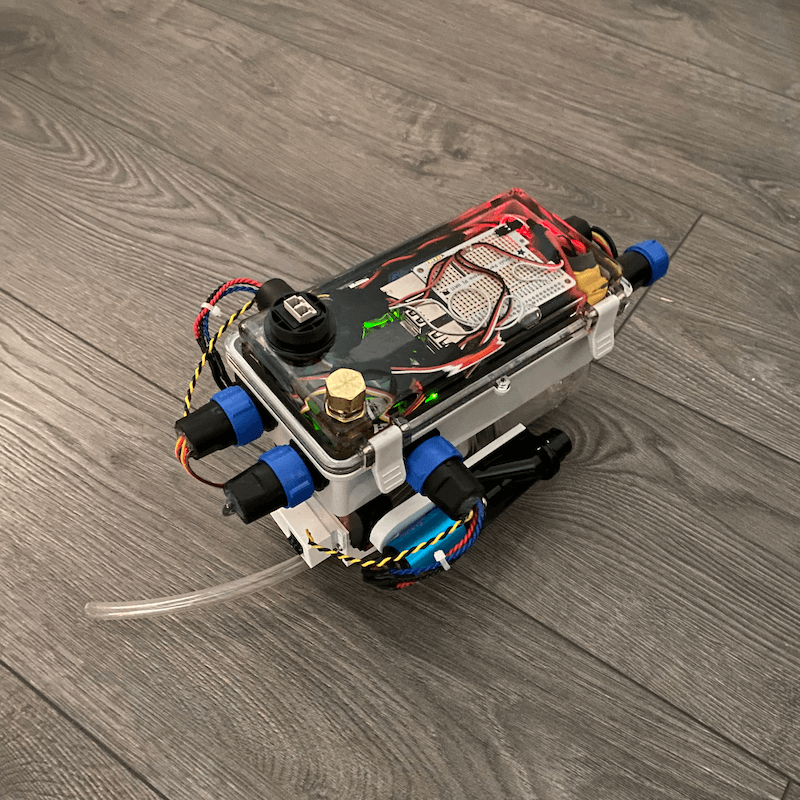
Overview
The sediment-sampling ROV was developed as a lower-cost platform for collecting samples in aquatic environments that are difficult or expensive to access with conventional equipment.
An operator pilots the vehicle with a standard gamepad while viewing live camera output in a browser. A Raspberry Pi inside the vehicle hosts the Node.js control interface and communicates with the surface computer through a fibre-optic tether.
Problem and context
Sediment can provide information about a local ecosystem and support the discovery of useful aquatic microbes, but deep-water collection typically needs costly equipment and larger vessels.
The project brief called for a system that could be deployed from a small vessel, survive underwater operation, transmit control and video over distance, and physically recover a sediment sample.
Technical approach
The vehicle combines a pressure enclosure, camera, lighting, thrusters, and a sampling mechanism in a remotely operated frame. Buoyancy and component placement were developed alongside the mechanical sampling hardware.
At the surface, gamepad inputs are captured by the browser application and sent as HTTP requests over the fibre link. The onboard Raspberry Pi translates those requests into vehicle actuation while returning the live camera feed.
Key engineering details
Communication
A fibre-optic tether carries the data link between the operator computer and the sealed onboard electronics without depending on underwater radio.
Operator interface
A Node.js server provides the browser UI, receives standard gamepad control inputs, and presents the live camera feed used for piloting.
Mechanical system
The frame, pressure housing, thruster arrangement, buoyancy, and sediment-collection mechanism were integrated as one deployable prototype.
Development process
Feasibility work and iterative design sprints covered the mechanical, electrical, communications, and control risks before the competition build.
Results and outcomes
The working prototype was demonstrated as a remotely piloted underwater vehicle with live video and sediment-sampling capability.
The project won first place in both the demonstration and pitchIt categories of its competition, receiving the $800 grand prize. The work was later discussed in a CBC Radio interview about climate technology.